
RAILWAY & AIOICHO / 1874 → NOW
The station arrived,
and the city began to move.
The area around present-day Aioicho changed dramatically with the birth of Kobe Station and the growth of the railway. Here is a 150-year story connected to streets you can still walk today.
WHY THE STATION MATTERS
Kobe Station did not arrive alone — it helped create the neighborhood around it.
Kobe City’s modern-history archive explains that when Kobe Station was built in 1874, a new urban district was formed in the Nakachobu area — including the Minatogawa, Aioi and Ujikawa surroundings — partly to relocate residents from the station site. Streets whose names survive today, including Nakamachi-dori and Tamon-dori, were laid out in this period.
Rail service opens between Kobe and Osaka.
Japan’s second government-operated railway opens between Osaka and Kobe, and Kobe Station is born. New urban development advances in the area that includes present-day Aioicho.
Aioi Bridge becomes a place to watch trains.
A bridge crossing the tracks stood east of Kobe Station. A print in the Kobe City Museum collection shows crowds gathering to watch steam trains pass beneath it.
A city map made for people arriving by rail.
The Kobe City Central Library preserves the Hyoshin Shigai no Zu, a map made for people arriving in Kobe by train. It even lists distances from Aioi Bridge to city sights.
The railway network stretches west.
Sanyo Railway opens the Hyogo–Himeji section in 1888, reaches Shimonoseki by 1901, and is nationalized in 1906 — forming part of today’s Sanyo Main Line.
The station rises; Aioi Bridge disappears.
The present third-generation Kobe Station building opens in 1930. In 1931, Aioi Bridge is removed as the railway is elevated, changing the relationship between tracks and streets.
Everyday life still gathers beside the railway.
Today Aioicho 4-chome mixes restaurants, offices, hotels, clinics and daily-life businesses. The forms have changed, but the station still concentrates movement around the neighborhood.
Today’s block boundaries and buildings are not direct continuations of the Meiji-era city. Still, the fact that station construction triggered new urban development around Aioi is essential context for understanding the area today.
WHAT REMAINS TODAY?
History is still visible in the structure of the city.
This is not a district filled with preserved old buildings. But when you notice the station, elevated tracks, street directions and gathering points, the transport framework created in the modern era becomes easier to see beneath today’s city.
Kobe City identifies the present station building as the third generation, opened in 1930. The station itself remains a piece of the neighborhood’s history.
Railway elevation in the early 1930s changed how the city met the tracks. Aioi Bridge vanished, but the railway still structures the area.
Some street names established during the new urban development around Kobe Station remain part of today’s city.
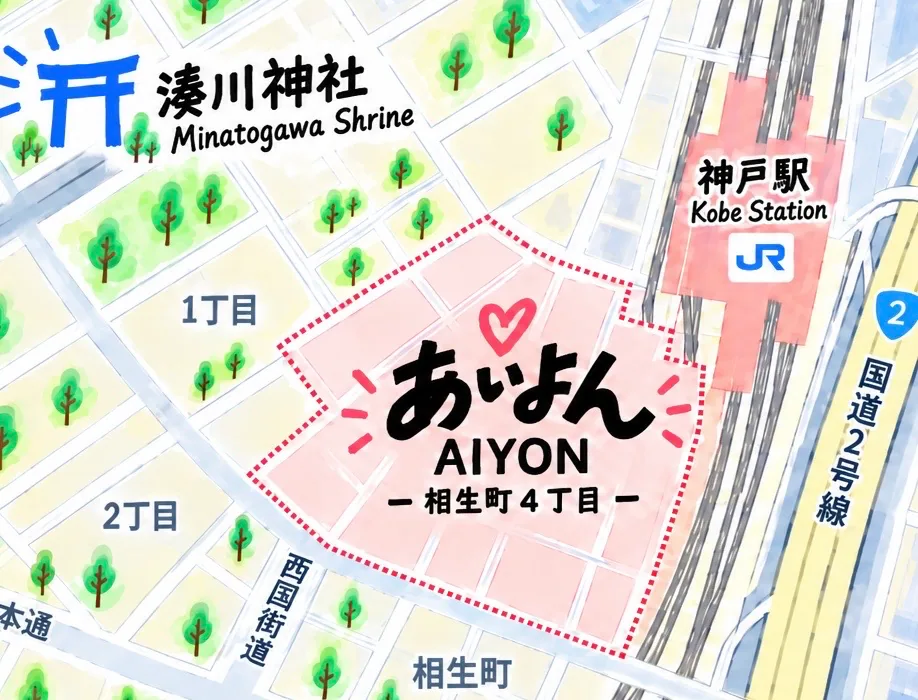
Aioicho 4-chome sits just northwest of Kobe Station. As you look at today’s shops, also notice how the station, tracks and streets shape movement through the neighborhood.
HISTORY → TODAY
History should not end as a story about the past.
AIYON covers history because knowing what sits beneath today’s shops and lanes makes an ordinary streetscape feel more dimensional. The point is not nostalgia — it is seeing the present more clearly.

“The same tracks feel a little different when you know they are part of a 150-year story.”